
Reliance Industries, the Tata group, Bharti Airtel and Aditya Birla are among Indian conglomerates that have hedged their revenue and costs linked to the US dollar, giving them financial cover as the rupee fell past 80 against the greenback on Tuesday.

Market benchmarks gave up intra-day gains to close in the red for the sixth session on the trot on Friday, capping a bruising week which saw a massive dash for safety amid rate hikes by global central banks and fears of slowing growth.

HUL was the top loser in the Sensex pack, shedding around 4 per cent, followed by Maruti, HDFC Bank, PowerGrid, IndusInd Bank, HCL Tech and Bajaj Finserv. On the other hand, Axis Bank, SBI, ONGC and ICICI Bank were among the gainers. NSE Nifty fell 149.95 points to 13,817.55.
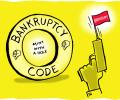
Even as lenders are getting ready to send more companies to bankruptcy courts from this week, several old cases are still awaiting resolution with no clarity on the completion of the process. This includes some high profile cases from the first list of 40 companies including Videocon Industries, Bhushan Power and Steel and Lavasa Corporation, sent by the Reserve Bank of India (RBI) for resolution. The delay is mainly due to litigation and late clarifications by various government agencies including the Reserve Bank of India and litigation by the Enforcement Directorate.

Licence winners are expected to be announced by the first quarter of 2014.

Sliding for the fifth straight session, the rupee fell 3 paise to close at a fresh lifetime low of 79.06 against the US dollar on Thursday amid a strong greenback overseas and unrelenting foreign fund outflows. At the interbank forex market, the local unit opened at 78.92 against the greenback and witnessed an intra-day high of 78.90 and a low of 79.07. It finally settled at 79.06, down 3 paise over its previous close of 79.03.

Equity benchmark Sensex climbed 154 points to end at a fresh all-time high on Monday, tracking gains in ICICI Bank, L&T and Kotak Bank amid persistent foreign fund inflows and a largely positive trend in global markets.
Flipkart Group on Monday said it has raised $3.6 billion (about Rs 26,805.6 crore) in funding led by GIC, Canada Pension Plan Investment Board (CPP Investments), SoftBank Vision Fund 2 and Walmart, valuing the e-commerce giant at $37.6 billion. The company, which competes with Amazon, Reliance Industries' JioMart and others in the burgeoning Indian e-commerce market, said it will continue to make deeper investments across people, technology, supply chain and infrastructure to address the requirements of a rapidly growing consumer base in the country. The current funding round has also seen participation from sovereign funds DisruptAD, Qatar Investment Authority, Khazanah Nasional Berhad as well as marquee investors Tencent, Willoughby Capital, Antara Capital, Franklin Templeton and Tiger Global.

In the 30-share Sensex constituents, 16 ended lower and 14 gained, helping the benchmark indices trim losses.

A strong start-up ecosystem can propel investment, jobs, and demand creation, and for that, substantial growth capital is required.

Besides the pandemic that resulted in higher interest rates, the default by Future Retail has dealt a blow to investor sentiment.

Walmart-owned Flipkart on Thursday said the company is in compliance with Indian laws, including FDI regulations, and will cooperate with the Enforcement Directorate on the notice sent to the e-commerce major. The Enforcement Directorate (ED) has issued a show cause notice of Rs 10,600 crore to Flipkart and its promoters for alleged violation of the foreign exchange law, official sources said on Thursday. When contacted, Flipkart said it is in compliance with Indian laws and regulations, including FDI regulations.

The RBI rejection is a second blow to BoB - the lead bank of both companies -- after a Delhi high court order on August 18 stayed a move by BoB and the entire consortium of lenders to classify these accounts as fraud, restraining them from taking any other coercive action till the next hearing.
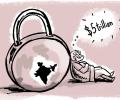
It would be a difficult task for the Indian economy to reach the $5-trillion mark a year before the International Monetary Fund (IMF) projection of 2026-27. Pankaj Chaudhary, minister of state for finance, said in the Rajya Sabha on Tuesday that the government is taking steps to make the country a $5-trillion economy at a date earlier than the IMF's projection. In that context, it would not be difficult to meet the projection in the third quarter of FY27.
A sluggish economy and stalled bureaucratic decision-making for the past two years thwarted capital investment and dented earnings, making it tough for the companies to raise funds.
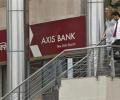
At the bank's current market price, the stake on offer is worth about Rs 5,700 crore

HDFC was the top gainer in the Sensex pack, rising around 3 per cent, followed by Bajaj Finance, HDFC Bank, IndusInd Bank, PowerGrid, UltraTech Cement, TCS, Tech Mahindra and L&T. On the other hand, ONGC, Maruti, Tata Steel, HUL, Bajaj Auto and Sun Pharma were among the laggards.

PowerGrid was the top gainer in the Sensex pack, rallying over 4 per cent, followed by NTPC, UltraTech Cement, Tech Mahindra, Reliance Industries and IndusInd Bank.

Nikunj Saraf, Vice President Choice Wealth, answers your queries.

M&M was the top gainer in the Sensex pack, soaring over 10 per cent, followed by L&T, IndusInd Bank, Bajaj Finserv, SBI, Bajaj Finance, ICICI Bank and Kotak Bank. On the other hand, HUL, ITC, Titan TCS and Bharti Airtel were among the losers.
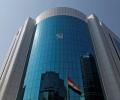
The Securities and Exchange Board of India (Sebi) on Monday relaxed the norms for valuing perpetual bonds. The norms, which had sought to value banks' deemed residual maturity of Basel III additional tier 1 (AT1) bonds as 100-year debt from April 1, were strongly opposed by the finance ministry. In a statement released on Monday, the regulator said the maturity would be 10 years until March 31, 2022, and would be increased to 20 and 30 years over the subsequent six-month period.

Many CEOs said they plan to give special leave to women employees so as to encourage their participation in the workforce.

Ajit Mishra, vice president, Research, Religare Broking, answers your stock market queries.

Ajit Mishra, vice president, research, Religare Broking, answers your stock market queries.

ONGC was the top gainer in the Sensex pack, rallying around 6 per cent, followed by NTPC, Tata Steel, ICICI Bank, ITC, Titan and Bajaj Auto. On the other hand, Axis Bank, M&M, Tech Mahindra, Asian Paints and Bajaj Finserv were among the laggards.

Ajit Mishra answers reader queries on the stock market.

The further expansion and upgrade of the Chinese military does not augur well for India, which continues to confront an increasingly belligerent China on its borders, notes former foreign secretary Shyam Saran.

Experts argue that the top two players in each category will receive funding sooner or later, but for laggards, the market is still challenging

Dalal Street investors became richer by more than Rs 16.36 lakh crore this year as the equity market scaled new highs despite persistent geopolitical uncertainties and inflation worries. Analysts attributed better macroeconomic fundamentals, the confidence of retail investors and foreign investors investing again in the domestic equities towards the latter half of 2022 as the key factors that led to the outperformance of the Indian market in comparison to many other stock markets worldwide. During the initial part of the year, markets were jolted by the Russia-Ukraine war.

L&T was the top gainer in the Sensex pack, soaring around 7 per cent, followed by Bajaj Finance, IndusInd Bank, NTPC, PowerGrid, M&M and Axis Bank. On the other hand, Reliance Industries Bharti Airtel and Maruti were the laggards.

Future Retail's independent directors had last week asked Amazon if it was willing to give a long-term loan to avoid default on repayment of Rs 3,500 crore loan due on January 29. Amazon replied to that saying it was willing to financially assist Future Retail through the Samara Capital deal but the retailer must shelve Rs 24,713 crore deal with the Reliance group.

Global markets trends, inflation, release of industrial output data and quarterly earnings will dictate movement of the equity benchmarks this week, analysts said, adding that volatility might continue amid slew of announcements of macroeconomic data at the global level too. Moreover, foreign fund movement, crude oil prices and trend in rupee would also act as major drivers for the equity market, they added. "The direction of global equity markets along with movement in dollar index and crude oil prices will continue to dominate while inflation numbers of the USA on May 11 and inflation and IIP numbers of India on May 12 will also cause volatility in the market," said Santosh Meena, head of research, Swastika Investmart Ltd.

Despite the $11.7 billion raised by Reliance Industries Ltd (RIL) through stake sales, venture investments in 2020 have declined by a fifth to $28.9 billion till September, consultancy firm EY said in a report on Thursday. Since mid-March, coronavirus infections started getting reported in the country, which has now become the second highest globally in terms of numbers. The lockdowns severely dented economic activity, leading to a 23.9 per cent contraction in the gross domestic product (GDP) for the April-June period and expectations of a 9.5 per cent contraction by the Reserve Bank of India (RBI) for 2020-21.

Nestle India was the top loser in the Sensex pack, shedding 2.20 per cent, on its first day as part of the index.

Reliance Industries was the top gainer in the Sensex pack, surging over 3 per cent, followed by Bajaj Finserv, IndusInd Bank, HDFC twins and Kotak Bank. NSE Nifty surged 143.25 points or 1.18 per cent to 12,263.55.

Richest Indian Gautam Adani's ports-to-power-to-cement conglomerate is "deeply overleveraged" with the group predominantly using debt to invest aggressively across existing as well as new businesses, CreditSights, a Fitch Group unit, said on Tuesday. In a report titled 'Adani Group: Deeply Overleveraged', CreditSights said, "In the worst-case scenario, overly ambitious debt-funded growth plans could eventually spiral into a massive debt trap, and possibly culminate into a distressed situation or default of one or more group companies." Starting out as a commodities trader in the late 1980s, the Adani group has diversified from mines, ports and power plants into airports, data centers and defence.

Bharti Airtel was the top gainer in the Sensex pack, rising around 3 per cent, followed by HUL, HDFC, ITC, IndusInd Bank, SBI, Sun Pharma, ONGC, Tech Mahindra, L&T and Asian Paints. On the other hand, Kotak Bank, Nestle India, Tata Steel, Bajaj Finance and HDFC Bank were among the laggards.

Soft oil prices are expected to persist in 2015 and will be accompanied by significant real income shifts from oil-exporting to oil-importing countries.

Ambani is in good company. The likes of ultra-rich individuals like hedge fund billionaire Ray Dalio and co-founder of Google Sergey Brin have chosen Singapore to establish their family offices. So have British inventor James Dyson, famous for his bladeless fans and hair dryers and vacuum cleaners, and Zhang Yong, founder of China's Haidilao hotpot restaurant chain, reports Lee Kah Whye.

In the Sensex pack, Vedanta rallied 3.20 per cent, followed by Tata Steel, M&M, Tata Motors, ONGC, Hindustan Unilever, Maruti, Hero MotoCorp, HDFC, Bajaj Finance, SBI, HDFC Bank, HCL Tech, Coal India, Sun Pharma, Infosys, Reliance and Bharti Airtel, rising up to 2.69 per cent.
 © 2026 Rediff.com - Advertise with us - Disclaimer - Privacy Policy - Sitemap - Feedback - About us - Terms of use - Grievances